
Why “Just tell us what to do” never works
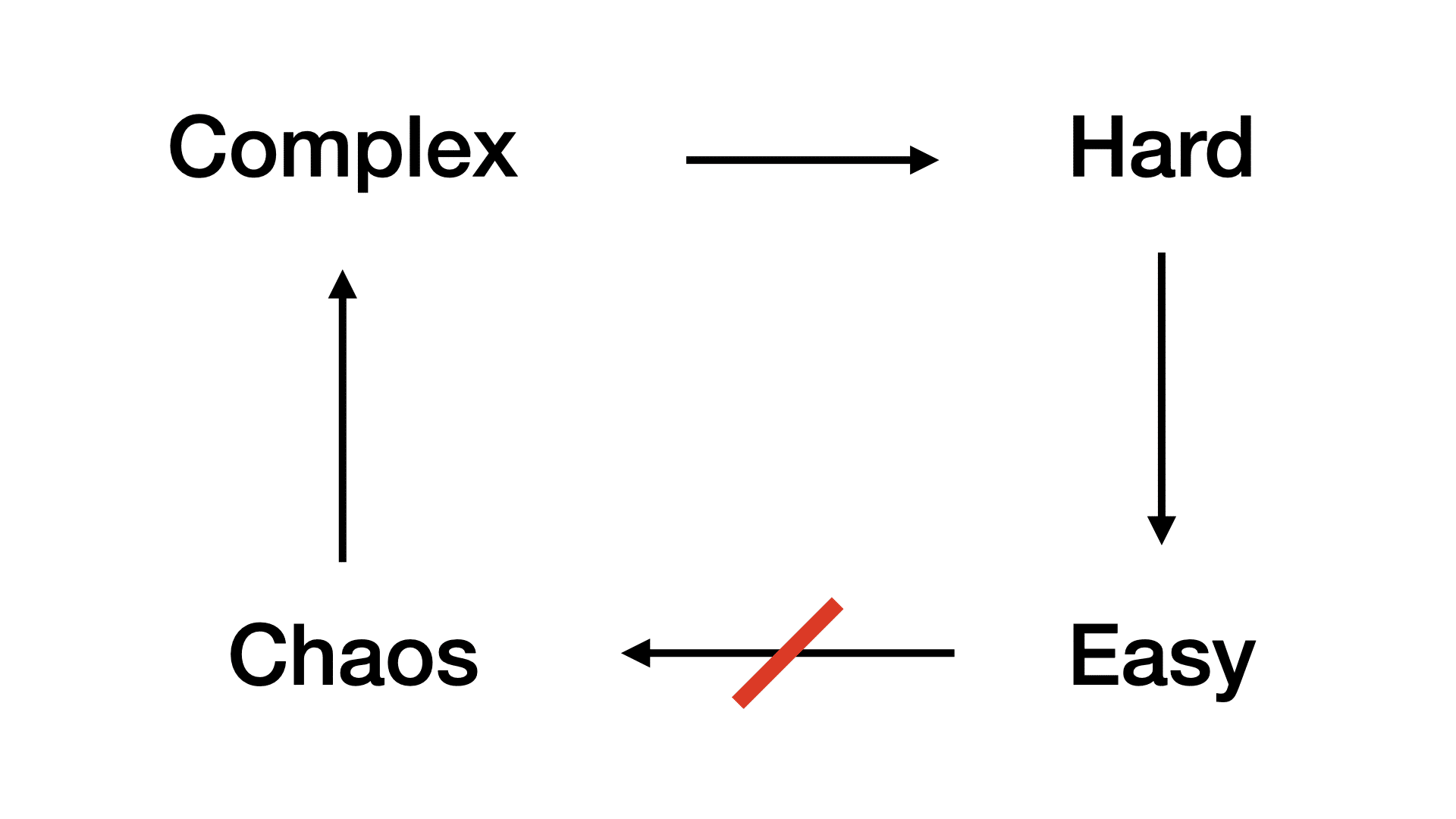
Hand over the to-do list and you dump more stuff into the client’s chaos. The team that executes has to walk the walk itself: Chaos, Complexity, Hard, then Easy and Simple.
Key takeaways
- I already know about 80% of what a client needs to do. The missing 20% can hold the real blockers.
- 5% is know-how, 95% is execution.
- The hard part is a loop: choose, prioritize, do, measure, learn, choose again.
- Starting with simple and easy means nothing happens, or it happens in the wrong order.
- With a good consultant the walk can be fast - a few days even - but you can not skip to the end.
I am a consultant, paid to solve the challenges of my clients. As of 2023 I have done this for 12 years with my second company, and a few years longer in other setups.
Most of my projects were a success. Most of those that weren’t were “Just tell us what to do” projects.
The request: tell us what to do, then get out again
The client has hired me, we agreed how to work together, then everything changes. Instead of close, intensive, sometimes annoying joint work, they just want to know what to do to reach X.
Mostly I refuse and insist on my approach:
- kick-off calls
- analysis
- question lists
- long and intensive multidisciplinary workshops
- live specifications of tasks and processes
- milestones
- in-team prioritization
Sometimes a client kept insisting because everyone was too busy - a huge red flag already - and I gave in. Does not happen nowadays.
Knowing 80% of the answer is not enough
- About 80% of what the client needs to do to reach X I already know. Most issues in my field are archetypical.
- Even if the issues are unique for the client, they usually are not.
- The missing 20% can hold the real blockers, those which block everything else.
For those I need insights, feedback, questions - and to experience how the people who will act on this really work.
5% is know-how, 95% is execution
The much bigger issue, as with everything that has value. The people who manage and act on the know-how must walk the walk.
The walk: Chaos → Complexity → Hard → Easy and Simple

Loosely based on the Cynefin Framework, in my own interpretation.
Chaos: lots of work, no value
When you start anything new, a lot is in the air:
- Ideas, tipps, tricks, approaches, ways to think about, opinions
- Old stuff, coming stuff, “We tried that before”s
- Data, demands, goals, mutually exclusive goals, reasons, suggestions

Acting on this means lots of work and no value - very likely negative value, as working based on chaos creates more chaos. So first move the chaos to complexity.
Complexity: one thing influences the other
Most things that are new and create value are complex. No discipline consists only of “low-hanging fruits”.
Once you understand that one thing influences others, which impact something else again, you see more than one path. Some overlap, others are mutually exclusive. I did mention that it’s complex?

- Complexity is not pretty.
- Complexity makes you see where you are and what there is.
- Complexity puts things in their place.
- Complexity connects.
- And out of complexity hard choices emerge.
Hard: choose, prioritize, do, measure, learn, repeat

After you have at least partially understood the complexity, the hard parts start:
- Choose how to think about your challenge and where to go. You might choose wrongly. Choosing includes measuring where you are (#StatusQuo).
- Prioritize what you will do, based on what you can do and when.
- Do it, for the first time. Nothing new that is worthwhile is ever easy.
- Measure: get feedback.
- Learn: most of the doing is learning. Now you experience what you did not know.
- Go to 1: choose again, based on the learning.
Simple and Easy: it all falls away

- What was hard gets easy.
- What was complex gets simple.
- What was chaos became a long distant memory.
The new challenge becomes daily business, then just things that are done this way.
Do not start with “Simple and Easy”
Some clients want to start at the end:
- Client: “Hey Franz, as your track record shows you seem to have figured out SEO. Tell us what we should do.”
- Franz: “Yeah, there is this multistep and multidisciplinary process where we go from where you currently are to a jointly specified project setup plus live specified SEO tasks, SEO processes, milestones, and KPIs. And enthusiastic commitment by the team to do it.”
- Client: “Sounds great. But well, we have a lot on our plate. Just tell us what to do.”

Don’t do it. It’s a trap.
Simple and Easy adds to the chaos

If you start with simple and easy, you just dump stuff into the chaos. Then:
- Nothing happens.
- Or things happen, but in the wrong order.
- Or things partly happen while other things work against them: an overall negative outcome for everybody.
The consultant loses too: only successful clients lead to new clients. And lifetime is limited: investing your time and resources into things that will not happen is just boring.
A good consultant walks the walk with you
If necessary the walk can be walked damn fast - in a few days even - at least until the hard part, and from there onto the right track to easy and simple.
But you can not just skip to the end. Then you have failed as a consultant: you added stuff to their challenges instead of solving them with them.
Work with me - if this post does not scare you. My name is Franz Enzenhofer. I am a consultant.